


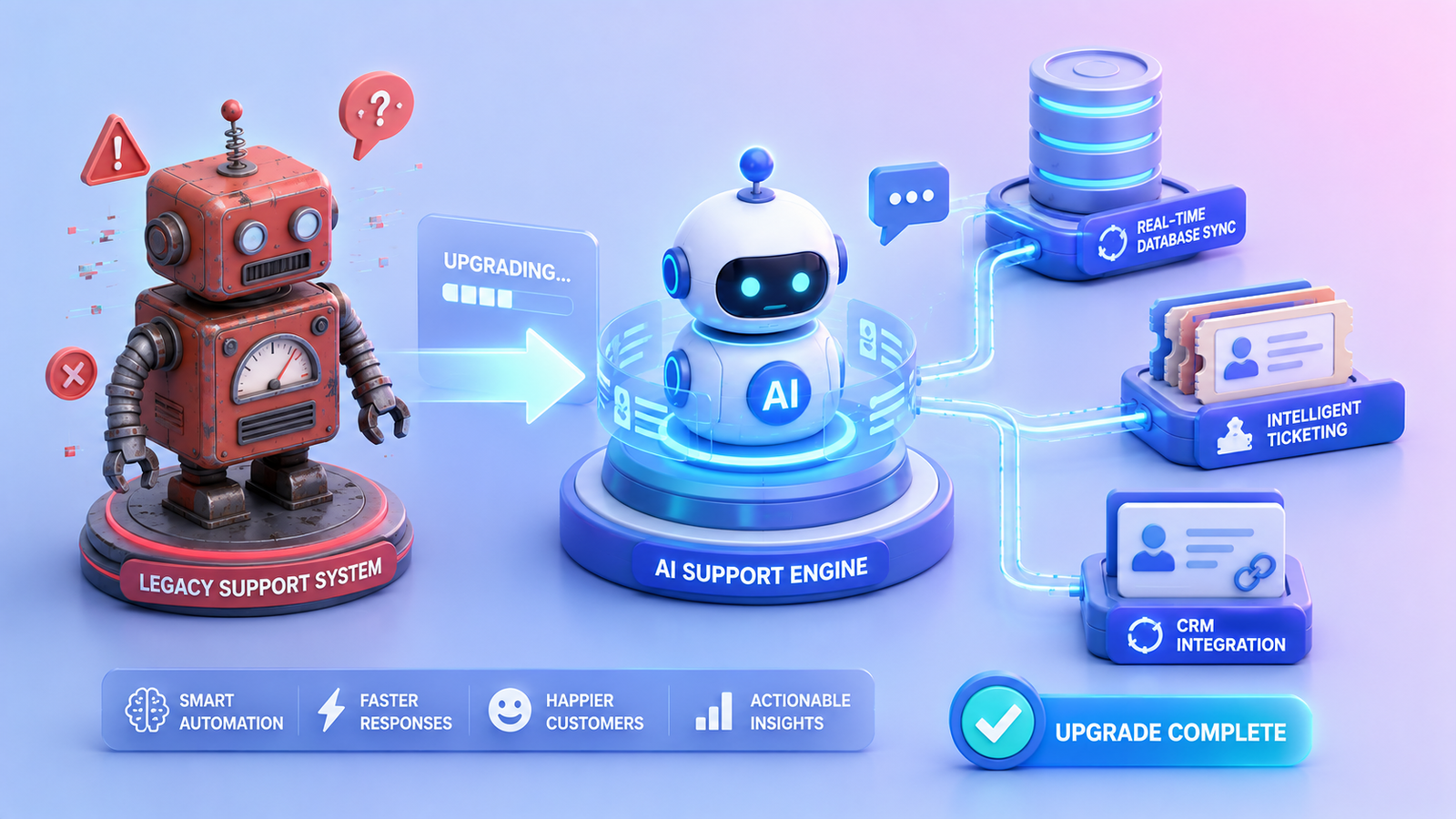
⚡ Quick Answer: What Makes a Modern Customer Support Stack in 2026?
A modern 2026 customer support stack transitions from legacy decision-tree chatbots to an AI-first, modular architecture. Instead of frustrating customers with static decision trees and dead-end links, a modern stack unifies your data sources (CRMs, help centers, databases), deploys conversational AI agents equipped with tool-calling capabilities, and connects directly to backend operational APIs. This allows systems to understand complex intent, maintain context across channels, and resolve customer issues end-to-end.
The Great Chatbot Fatigue: Why 1st-Gen Bots Failed
We have all experienced it: typing a detailed question into a website chat widget only to be greeted by a rigid bot that responds with, “I didn’t quite catch that. Here are 3 generic articles from our Help Center.”
First- and second-generation support bots were built on rigid rule trees. They forced users down narrow branching paths and broke down whenever a customer spoke like a human being. Rather than solving problems, they acted as digital brick walls designed to shield support teams from work.
In 2026, customer tolerance for these “annoying bots” has hit zero. Modern support engineering requires shifting from deflection-focused barriers to resolution-focused AI stacks.
Legacy Support Stack vs. 2026 AI-First Architecture
| Component | Legacy Support Stack (2020–2024) | Modern AI-First Stack (2026+) |
|---|---|---|
| Primary Bot Logic | Rigid decision trees & keyword matching | Large Language Models (LLMs) with RAG & Tool Calling |
| Data Architecture | Siloed help desk articles and disconnected CRMs | Unified vector databases & bi-directional API connectors |
| User Experience | Monologue Q&A, static text responses | Multi-turn, context-aware dialogue with action capabilities |
| Handoff Mechanism | Cold drop into a generic human ticket queue | Warm handoff with real-time AI conversation summaries |
| Primary KPI | Ticket deflection rate (reducing contacts) | First-contact resolution (FCR) & customer satisfaction (CSAT) |
The 3 Core Layers of a Modern Support Tech Stack
Upgrading your customer support stack doesn’t require scrapping every tool you own. It means reorganizing your infrastructure around three distinct, interconnected layers:
+-----------------------------------------------------------------------------------+
| 1. CONVERSATIONAL FRONT-END LAYER  (Web Chat, Email, WhatsApp, Social Messaging) |
+-----------------------------------------------------------------------------------+
                                          |
                                          v
+-----------------------------------------------------------------------------------+
| 2. INTELLIGENCE & KNOWLEDGE LAYER  (RAG Engine, Vector DB, Guardrails & LLMs)    |
+-----------------------------------------------------------------------------------+
                                          |
                                          v
+-----------------------------------------------------------------------------------+
| 3. ACTION & EXECUTION LAYER        (Stripe, Shopify, HubSpot, Zendesk, ERP APIs) |
+-----------------------------------------------------------------------------------+
1. The Conversational Front-End Layer
Your front-end must support fluid, omnichannel interactions. Whether a customer starts a chat on desktop, replies via email, or sends a message on WhatsApp, the conversation interface must recognize their identity and pull ongoing session context without making them repeat themselves.
2. The Intelligence & Knowledge Layer
This is the brain of your stack. Instead of relying on static FAQ pages, modern stacks use Retrieval-Augmented Generation (RAG) to index your internal documentation, Notion pages, and policy docs in real-time.
When a user asks a question, the intelligence layer searches your verified knowledge base, verifies policy guardrails, and crafts a clear, human-sounding response.
3. The Action & Execution Layer
The defining feature of a 2026 support stack is its ability to take action. Through secure webhooks and API function calling, your support engine connects directly to backend business tools (like Shopify, Stripe, or custom SQL databases) to execute tasks like issuing returns, updating accounts, or checking live inventory.
Step-by-Step Blueprint: Upgrading Your Stack
📌 Implementation Rule: Never deploy AI over fragmented data. Fix your knowledge foundation before adding automated execution layers.
Step 1: Centralize and Structure Your Internal Knowledge
Gather your company’s scattered documentation—SOPs, return policies, billing guides, product manuals—and clean them into structured markdown files. Remove outdated or conflicting information, as AI models reflect the quality of the data fed to them.
Step 2: Implement a Middleware Automation Engine
Integrate an automation orchestration layer like n8n, Make, or enterprise middleware. This layer sits between your conversational AI platform and your databases, serving as the secure broker for API calls and actions.
Step 3: Establish Clear Guardrails and Escalation Paths
Set up strict permissions for autonomous actions. Configure low-risk requests (e.g., checking shipping status or changing account details) for full automation, while requiring human approval for sensitive financial transactions or complex edge cases.
Step 4: Implement AI-Powered Agent Copilots
Upgrade your human support reps’ workspace with AI copilots. When a ticket escalates to a human agent, the copilot should automatically summarize the conversation history, suggest drafted responses, and fetch relevant user account details instantly.
Strategic Takeaway
Upgrading your customer support stack for 2026 isn’t just a technical upgrade—it’s a fundamental strategy shift. By replacing passive, rule-based chatbots with action-oriented, context-aware AI support systems, you eliminate friction, drastically improve First-Contact Resolution, and turn your support operations into a growth driver.